
Part VI: Bonus Material
2. Energy Standards and Certifications
Energy standards and certifications play a central role in Swiss new-build projects. They influence construction quality, operating costs, comfort, financing conditions, and sometimes even resale value.
This chapter explains the most common labels and regulations you will encounter as a buyer—and, more importantly, what they actually guarantee (and what they don’t).
Minergie Standard
Minergie is Switzerland’s most widely known voluntary building standard. It goes beyond legal minimum requirements and focuses on energy efficiency, comfort, and building quality.
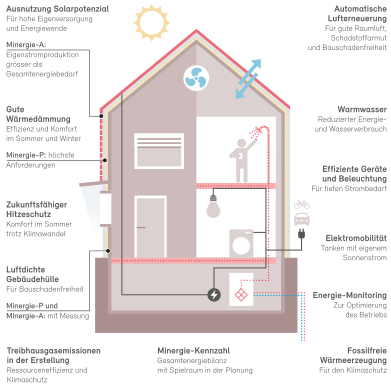
Core principles
Minergie-certified buildings must meet requirements in three main areas:
- Energy efficiency
- Low heating demand
- Efficient building envelope (insulation, airtightness)
- Comfort
- Mechanical ventilation with heat recovery
- Controlled indoor climate
- Quality assurance
- Planning and execution checks
- Documentation of systems and performance
Minergie does not prescribe a specific technology (e.g. heat pump vs district heating), but it strongly favors low-carbon solutions.
Minergie variants
-
Minergie
- The baseline standard
- Common in new residential developments
-
Minergie-P
- Stricter energy limits
- Very high insulation and airtightness
- Comparable to “passive house” concepts
-
Minergie-A
- Requires on-site renewable energy production
- Annual energy balance close to zero
Minergie-ECO
The Minergie-ECO label can be added to any Minergie variant (Minergie, Minergie-P, or Minergie-A).
It expands the focus beyond energy to include:
- Healthy indoor materials
- Limits on harmful substances (e.g. VOCs, formaldehyde)
- Ecological construction
- Environmentally responsible materials
- Lifecycle considerations
- Improved indoor air quality
- Stricter requirements for ventilation and finishes
Minergie-ECO does not improve energy efficiency further.
It focuses on health, materials, and environmental impact.
Minergie-ECO is particularly relevant for:
- Families
- Allergy-sensitive occupants
- Buyers concerned with long-term indoor health
Minergie certification applies to the building as a whole, not to individual apartments.
SNBS – Swiss Sustainable Building Standard
The SNBS standard takes a broader view of sustainability than Minergie.
While Minergie focuses mainly on energy and comfort, SNBS evaluates buildings across three dimensions:
- Environment
- Energy use
- CO₂ emissions
- Materials and resource efficiency
- Economy
- Life-cycle costs
- Durability and adaptability
- Society
- Usability
- Accessibility
- Integration into surroundings and infrastructure
Certification levels
SNBS certification is awarded in three levels:
- Bronze
- Entry level
- Demonstrates compliance with sustainability criteria
- Silver
- Balanced and well-optimized sustainability performance
- Gold
- Exemplary sustainability across all dimensions
Certification is achieved through:
- Structured planning documentation
- Independent evaluation
- Quantitative scoring across multiple criteria
SNBS is often used for:
- Large residential developments
- Public or institutional projects
- Long-term investment properties
SNBS signals a holistic, long-term sustainability approach, but it is less common in purely private developments due to higher planning and documentation effort.
HPE and THPE Labels
In some French-speaking cantons, you may encounter HPE and THPE labels.
-
HPE (Haute Performance Énergétique)
- High energy performance
- Roughly comparable to Minergie
-
THPE (Très Haute Performance Énergétique)
- Very high energy performance
- Comparable to Minergie-P
These labels serve a similar purpose to Minergie but are embedded in cantonal subsidy and regulation frameworks.
HPE/THPE are functionally similar to Minergie standards but are administered at cantonal level.
Energy Certificate for Buildings (CECB / GEAK)
The Energy Certificate for Buildings—known as CECB (French) or GEAK (German)—is a standardized energy rating system.
What it shows
- Overall energy efficiency (A–G scale)
- Heating system efficiency
- CO₂ emissions
For new buildings, the certificate is usually A or B, reflecting modern construction standards.
What buyers should know
- The certificate is informational, not a quality guarantee
- It reflects calculated performance, not actual usage
- Useful for comparing buildings, not apartments within the same building
In summary:
- Cantonal regulations define the legal minimum
- Minergie / HPE / THPE indicate higher comfort and efficiency
- SNBS signals long-term sustainability thinking
- Energy certificates help with comparison but have limits
A higher standard usually means:
- Lower running costs
- Better indoor comfort
- Higher construction quality
- Stronger long-term value
In the next chapter, we look at comfort, maintenance, and long-term efficiency—and what owners are responsible for once the building is occupied.