
Part I: Introduction to the Swiss Real Estate Market
5. Housing Cooperatives
Cooperatives are a distinct and influential part of the Swiss housing landscape. While not always accessible to private buyers, they play a crucial role in keeping urban housing affordable, preventing speculation, and shaping long-term development policy.
This chapter explains what housing cooperatives are, how they function, and when it might make sense to consider one.
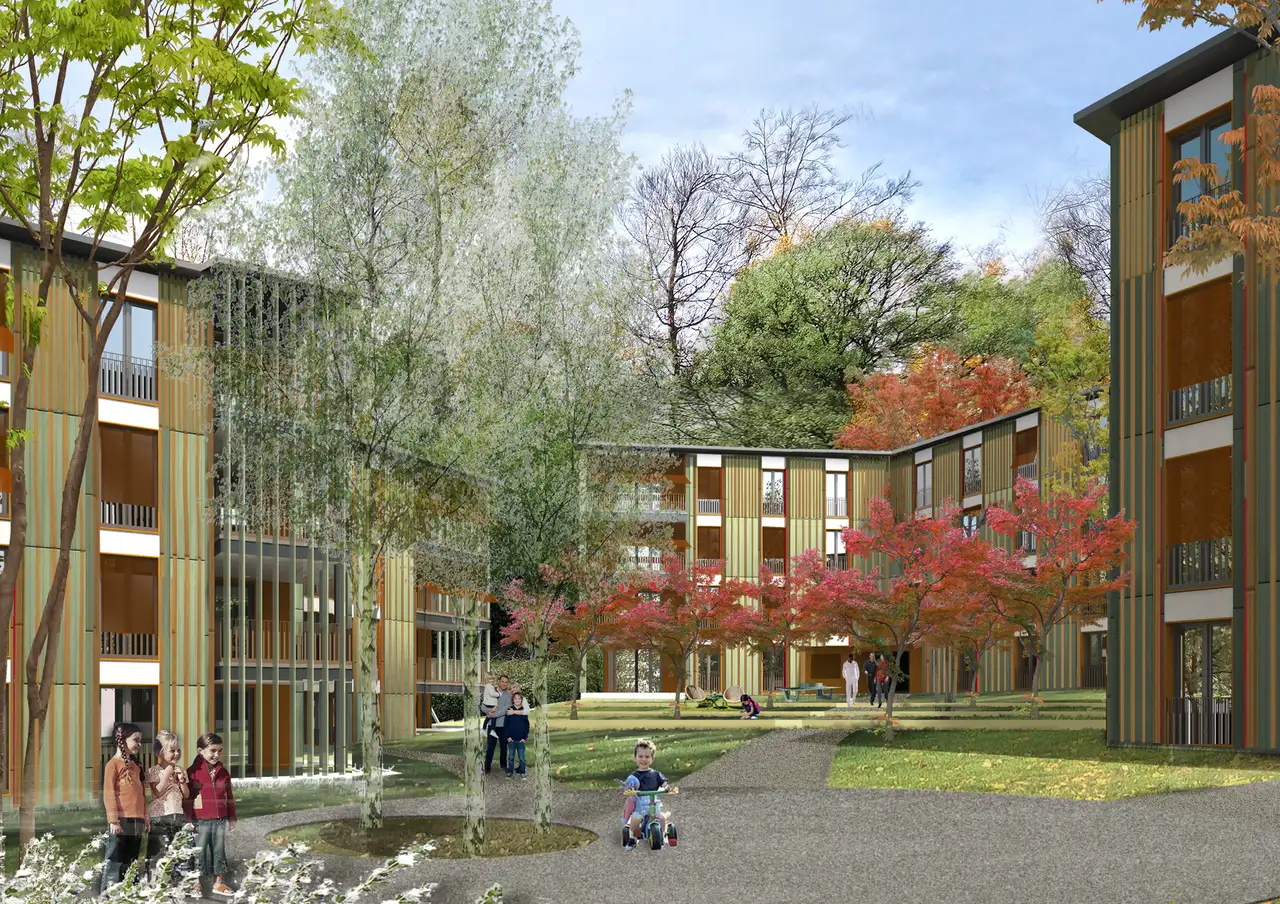
5.1 What Is a Cooperative?
A housing cooperative (Wohnbaugenossenschaft in German, coopérative d’habitation in French) is a non-profit legal entity that owns residential buildings and rents them out to members at cost—not market rates.
Key features:
- Residents are members and hold shares in the cooperative, but do not own their apartment.
- Rents are based on cost coverage, not profit (including maintenance, reserve fund, debt repayment).
- The cooperative reinvests surplus into renovations or new projects—no dividends are paid out.
- Buildings are often designed with long-term livability, sustainability, and community in mind (e.g. shared spaces, common rooms, gardens).
In essence, Genossenschaften function as collective, permanently affordable landlords. Zurich alone has over 60,000 cooperative apartments[1], housing roughly one in five residents.
5.2 Who Can Live in One and How Selection Works
To live in a cooperative, you typically must:
- Become a member, which involves buying a share certificate (Genossenschaftsanteil / part sociale)
- Meet the cooperative’s admission criteria, such as:
- Income and family size limits
- Commitment to community life
- Preference for car-free living (many cooperatives do not provide parking spaces)
- Sometimes residency status or canton-specific rules
Application processes vary but can include:
- Submitting personal motivation letters
- Participating in interviews or information sessions
- Joining waiting lists (which can be long in cities like Zurich or Geneva)
- Being recommended by an existing member, which in some cooperatives is informally expected or even required
In well-established cooperatives, units often circulate within internal networks. It’s not unusual for an apartment to become available only when a current member recommends a friend or family member. Without a referral, your application may be overlooked—even if you meet all other criteria.
The City of Zurich maintains a directory of active housing cooperatives that you can consult to see if any are available in your desired neighbourhood.
While this strengthens community bonds, it also means that access can be opaque or exclusionary, especially for newcomers or foreigners unfamiliar with the system.
Many cooperatives prioritize families, long-term tenants, or those displaced by redevelopment. Some offer internal transfer rights, allowing members to move between units as their needs change (e.g., with a birth of a child).
5.3 Cost Advantages and Limitations
Advantages:
- Below-market rents (often 20–40% lower than private market)
- Long-term security of tenure
- Minimal rent increases (only for inflation or cost coverage)
- High-quality construction and maintenance standards
Limitations:
- No resale value: You don’t “own” the apartment and cannot sell it at a profit.
- Share deposits are refundable but non-appreciating.
- Modifications and subletting may be restricted.
- Not always accessible to foreigners or high-income earners.
- Mobility can be limited—you may wait years for a suitable unit, and relocation requires cooperative approval.
You are not building personal equity as in private ownership, but you are gaining cost stability and housing security.
5.4 Role in Urban Planning
In cities like Zurich, housing cooperatives are not just tolerated—they are strategically promoted as part of long-term housing policy.
Zurich has an official target: one third of the city’s rental housing stock should be cooperative-owned[2][3]. This goal is supported through:
- Land leases on city-owned plots at favorable conditions
- Planning requirements for mixed-income developments
- Direct partnerships with cooperative associations
- Requiring large new urban developments (e.g. Zurich’s Greencity or Kalkbreite) to reserve apartments for cooperatives
Cooperatives are seen as a counterweight to real estate speculation, helping to preserve social diversity and affordability in growing urban areas.
5.5 Cooperative vs Normal Rent
Cooperative housing occupies a unique position between private homeownership and market-based renting. It offers the stability and long-term affordability of ownership—without requiring the financial commitment or risk—and better protections than typical rental agreements.
Here’s how cooperative housing compares to private rental:
| Consider a Cooperative If… | Consider Private Renting If… |
|---|---|
| You value cost stability over time | You prefer flexibility and the option to move often |
| You meet income or community criteria for cooperative housing | You don’t qualify for cooperative membership or prefer speed |
| You’re comfortable with non-ownership, in exchange for better rent | You want less oversight and fewer community obligations |
| You are open to shared spaces or communal living values | You prioritize full independence and fewer housing rules |
| You want long-term housing security without speculation | You see your housing needs as short-term or transitional |
Getting into an existing cooperative can take years, especially in popular neighborhoods where waiting lists are long and apartments are passed along privately via referral.
Newly built cooperative projects often release multiple units at once—creating rare opportunities to join without needing personal connections.
Huusli helps discover new projects (including cooperatives) early, even in the planning stage.
Stadt Zürich: Gemeinnütziger Wohnungsbau — https://www.stadt-zuerich.ch/statistik ↩︎
SRF: Bezahlbare Mieten dank weniger Luxus — www.srf.ch/news/wohnen-in-zuerich-bezahlbare-mieten-dank-weniger-luxus ↩︎
Stadt Zürich: Stadtratsbeschluss — www.stadt-zuerich.ch/de/politik-und-verwaltung/politik-und-recht/stadtratsbeschluesse/2012/Jul/StZH_StRB_2012_0819.html ↩︎