
Part II: Pre-Purchase Preparation
1. Understanding Swiss Property Law
Buying a new apartment in Switzerland—especially off-plan—requires navigating a unique legal environment. While the country’s legal system is known for its stability and transparency, property law is not centralized: many rules depend on the canton where the property is located.
This chapter provides a foundational overview of the legal structure, the key actors, and the regional differences you’ll encounter.
1.1 Legal Framework for New Builds
Buying a new or off-plan apartment is governed by a mix of federal law, cantonal practice, and industry norms. Unlike in some countries, there is no single national law for buying “off-plan”—but the process is well-established and legally recognized.
Contractual Structure
When buying before construction is complete, the transaction typically involves two key legal stages:
-
A contractual reservation or promise of sale:
- Often signed once building permits are in place and the developer starts marketing.
- Sets the price, building specifications, payment schedule, and delivery terms.
- May include technical annexes (plans, materials, etc.).
-
A notarized deed of sale (acte de vente / Kaufvertrag):
- Executed upon or near completion.
- Triggers formal ownership and land registry entry.
Key Legal References
- Swiss Code of Obligations (CO) – Articles governing sales contracts (Art. 184–236), construction contracts (Art. 363–379), and warranties (Art. 210, 371).
- Land Register Ordinance (LRO) – Governs registration, ownership structure, and PPE shares.
- SIA Norms – Standardized architectural and engineering codes, often referenced in contracts.
Legal protections include mandatory 5-year defect liability and safeguards like land registry reservations or construction guarantees (depending on canton).
1.2 Key Parties Involved
A typical new-build purchase involves multiple actors, each with specific roles and legal responsibilities:
| Party | Role |
|---|---|
| Bauherr (Client / Project Owner) | The person or entity commissioning the project and assuming ultimate responsibility for its financing, permits, and completion. In most off-plan apartment projects, the developer is the Bauherr until handover. |
| Developer (Promoter) | Coordinates project development, marketing, and sales. Often the Bauherr in multi-unit developments. May hire a Generalunternehmer or Totalunternehmer to execute construction. |
| Totalunternehmer (TU) | A single contractor responsible for planning and construction. The TU hires architects and trades, delivering a turnkey building. |
| Generalunternehmer (GU) | A single contractor responsible for construction only, using plans provided by the Bauherr’s architect. |
| Notary | Authenticates the sale and registers ownership in the land register. Neutral under Swiss law. |
| Land registry office | Records legal title, mortgage liens, and PPE (condominium) structure. |
| Financing bank | Provides mortgage financing and may manage staged payments. |
| Buyer | Commits to payments and approvals, takes possession at handover. |
The notary is neutral under Swiss law. Even though the buyer typically pays for the notary, their role is to ensure legality for both parties—not to act as legal counsel.
In some cases, a project manager or external trustee (fiduciaire) is involved to coordinate escrow accounts or ensure compliance with construction financing terms.
1.3 Rights and Obligations of the Buyer
When you buy into a new-build project, you take on both rights and binding obligations, many of which activate before the property is complete.
Rights
- Legal title to a defined unit (via PPE structure)
- Delivery of the unit as described in plans and specifications
- Protection against construction defects for 5 years
- Right to participate in the owners’ association once the building is handed over
- Legal recourse in case of delay, misrepresentation, or breach
Obligations
- Timely payment of staged amounts tied to construction milestones
- Acceptance of minor variations allowed in building code/specifications
- Participation in shared building costs and PPE reserve fund
- Coordination with mortgage bank (if applicable) for payment release
- Acceptance of ownership and handover once completion is confirmed
Some contracts allow limited withdrawal rights (e.g. if construction delays exceed a threshold), but you are usually fully committed after signing the contract, unless the developer defaults.
1.4 Canton-Specific Laws and Zoning Restrictions
Switzerland is a federal state, and cantons hold significant authority over land use, building permits, zoning, and taxation. What is allowed in one canton may be restricted or taxed differently in another.
Examples:
- Vaud: Stricter rules for secondary residences; strong tenant protections.
- Zurich: Detailed building codes; public notaries handle transactions.
- Valais: Popular for vacation homes but subject to Lex Weber (limits on second homes).
- Ticino: Allows foreign buyers in designated zones but with oversight.
- Geneva: High planning control, strict buyer vetting, and frequent sealed-bid processes.
Always verify zoning status (e.g. primary residence, vacation zone, mixed-use), and check for construction moratoria, especially in resort municipalities.
A property’s status as “second-home eligible” or not is often determined by municipality, not canton—make sure to check the local rules before committing.
1.5 Primary vs. Secondary Residences
One of the most critical distinctions in Swiss property law is between primary and secondary residences:
| Type | Description | Legal Notes |
|---|---|---|
| Primary residence | Your main legal residence (registered address) | Freely allowed for residents with legal status |
| Secondary residence | A vacation or part-time home, not your main address | Heavily regulated in many communes, especially post-2012 |
Legal Implications:
- Lex Weber (2012): Limits the share of secondary residences to max 20% per municipality[1].
- Lex Koller: Restricts foreigners (non-residents) from buying secondary homes unless in approved areas.
- Some cantons require buyers to use the property as their main address, especially for subsidized or cooperative units.
Pricing Differences in Mixed-Use Buildings
In places Davos, Lenzerheide, and other popular touristic/alpine areas, it’s common to find buildings where some units are designated as primary residences and others as secondary residences. These legal designations directly affect both usage rights and pricing:
- Secondary residence units are often significantly more expensive than comparable primary residences in the same building.
- This price gap is driven by limited supply (due to Lex Weber restrictions) and strong demand from non-resident buyers.
Here is the new condominium project Felina in Davos Dorf on Huusli, which includes both primary and secondary residence units in the same building:
| ID | Type | Size | Outdoor Space | Floor | Rooms | Price |
|---|---|---|---|---|---|---|
| 1 | Primary | 94.4m² | Garden: 102m², Patio: 26m² | Ground | 2.5 | 1’200’000 CHF |
| 2 | Secondary | 132.7m² | Garden: 285m², Patio: 53m² | Ground | 3.5 | 2’650’000 CHF |
| 3 | Primary | 99.0m² | Balcony: 16m² | Upper | 2.5 | 1’250’000 CHF |
| 4 | Secondary | 126.0m² | Balcony: 33m² | Upper | 4.5 | 3’250’000 CHF |
| 5 | Secondary | 178.0m² | Balcony: 38m² | Roof | 5.5 | 4’450’000 CHF |
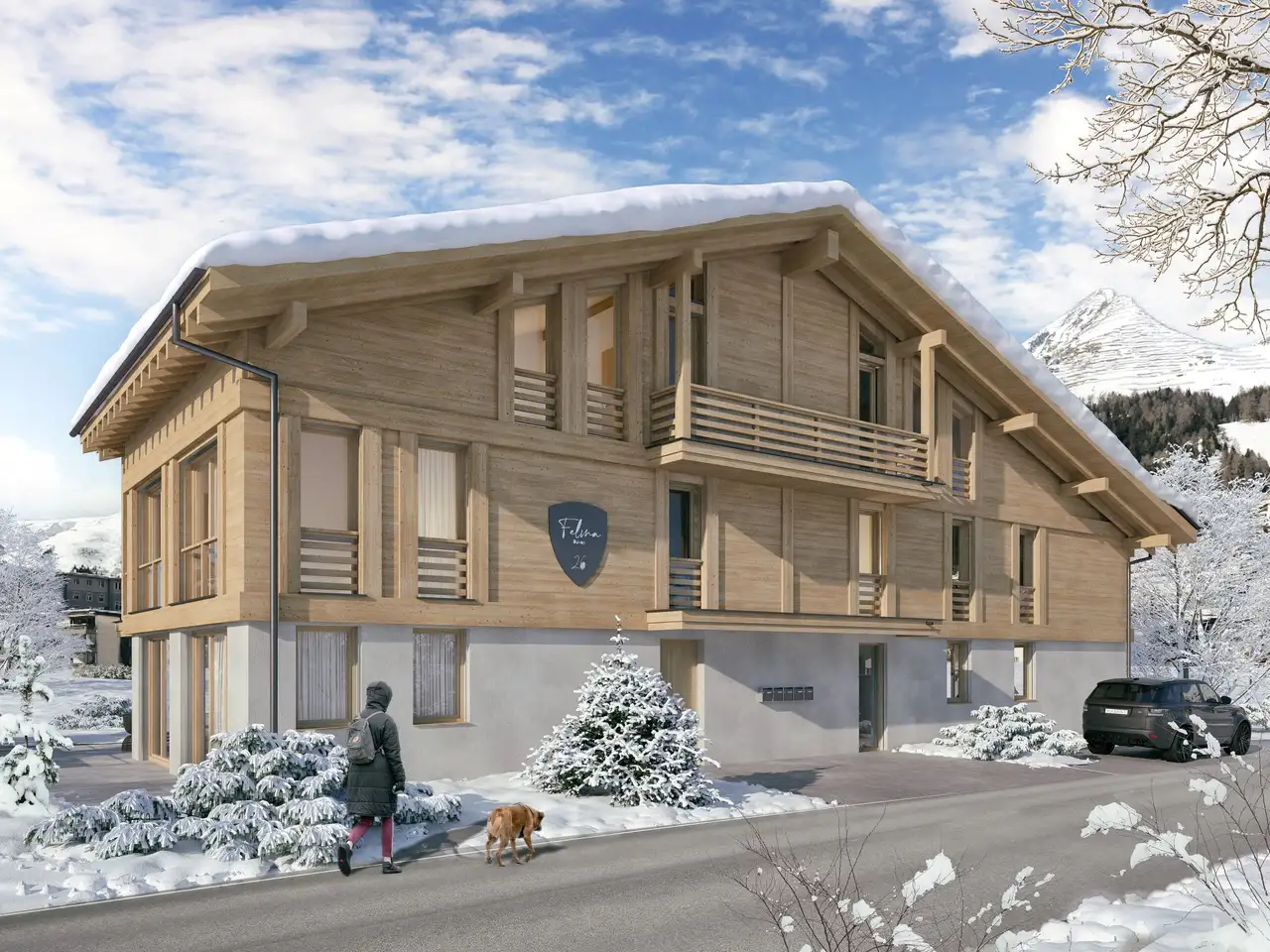
Units #1 and #3 are legally restricted to be primary residences, and can only be bought by someone who will use them as their main address. They are significantly cheaper than comparable secondary units on the same floor or in the same building.
Before buying, ask:
- Will I be allowed to use this as a second home?
- Is the municipality already over the 20% secondary residence cap?
- Will I need to declare this as my tax residence?
1.6 Hotel-Managed Residences
In response to the restrictions of Lex Weber, a growing number of new developments in Swiss mountain resorts are now structured as hotel-managed residences.
These units are legally part of a commercial hospitality operation, not counted as secondary residences. This allows new construction even in municipalities that have already reached or exceeded the 20% cap on second homes.
How it works:
- You buy an apartment in a resort complex that is contractually linked to a hotel operator.
- The apartment is placed into a rental pool managed by the hotel, marketed to tourists and maintained year-round.
- As the owner, you have the right to use the apartment for a limited number of weeks per year (often 6–10 weeks).
- Use during high season (Christmas, February, summer) is typically restricted or shortened.
- The rest of the year, the apartment must remain in the hotel rental system.
Legal and Financial Aspects
- Rental income is pooled and distributed among owners after deducting the hotel’s management and service fees.
- Operating costs (cleaning, maintenance, furniture, marketing) are shared.
- Some contracts might include a guaranteed minimum return, but most depend on actual occupancy rates.
- Not all Swiss banks offer mortgages for this type of property — the financing is more complex and often treated like a business investment.
Examples:
- PRIVÀ Alpine Loddge in Lenzerheide/Lai (4 weeks per year own usage, pooled income)
- Sulai in Flims (3 weeks per year own usage in high season)
“Lex Weber” – Federal Second Home Initiative (2012). See also: Federal Office for Spatial Development ARE ↩︎